
Bank Custody Services Instruction Management on Salesforce
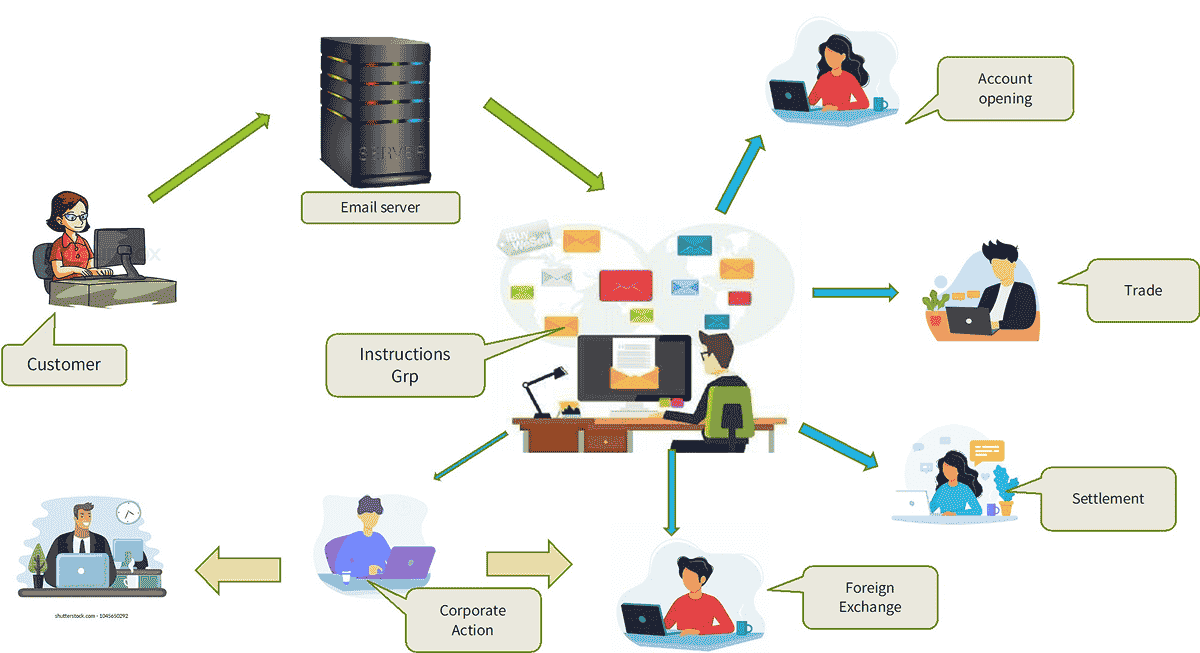
A Salesforce Service Cloud–based custody instruction processing solution to convert customer instruction emails into governed Custody Cases, enable automated distribution to processing groups, enforce maker-checker validations, track TAT/SLA with escalations, maintain a complete audit trail, and integrate with DMS (Document Management System) for closed-case document storage—secured with SSO (SAML).
Who this is for
This solution is designed for Indian banks / custody service operations that receive high volumes of customer instructions over email and require a single, auditable system-of-work to manage end-to-end processing across multiple internal teams (instructions, corporate actions, FX, account opening, trade capture, etc.) with strong governance and controlled handoffs.
Typical Users:
What the Solution Enables
A single Salesforce-based custody operations system-of-work with the following capabilities:
Why Banks Adopt This (Key Pain Points Solved)
Custody instruction processing is often email-heavy and team-dependent, which creates risk and inefficiency. This solution addresses:
Solution Architecture (High Level)
Salesforce Service Cloud is the core system-of-work for custody instruction processing, supported by:
Functional Modules (Productized)
Module 1 — Custody Case (Instruction) Master + Lifecycle Governance
Purpose: Maintain a single Custody Case as the work item for each instruction with controlled stage progression.
Key Capabilities
Module 2 — Email-to-Case Intake + Customer Acknowledgement
Purpose: Convert inbound customer instructions into cases and confirm receipt.
Key Capabilities
Module 3 — Instructions Team Triage + Automated Distribution
Purpose: Enable centralized triage and systematic distribution to execution teams.
Key Capabilities
Module 4 — Processing Group Execution Workbench (Queue-Wise)
Purpose: Provide a standardized execution flow for each processing group while maintaining segregation.
Key Capabilities
Module 5 — Maker–Checker Validations (Four-Eye Verification)
Purpose: Reduce operational risk by enforcing approvals at each stage.
Key Capabilities
Module 6 — Audit Trail + Significant Data Change Tracking
Purpose: Ensure end-to-end traceability and compliance evidence.
Key Capabilities
Module 7 — TAT Management + Escalations
Purpose: Improve timeliness and eliminate TAT breach risk.
Key Capabilities
Module 8 — DMS (Document Management System) Integration for Closed-Case Document Storage
Purpose: Ensure governed archival storage and reduce attachment loss risk.
Key Capabilities
Module 9 — Reports and Dashboards (Operational MIS)
Purpose: Provide real-time operational visibility to supervisors and governance stakeholders.